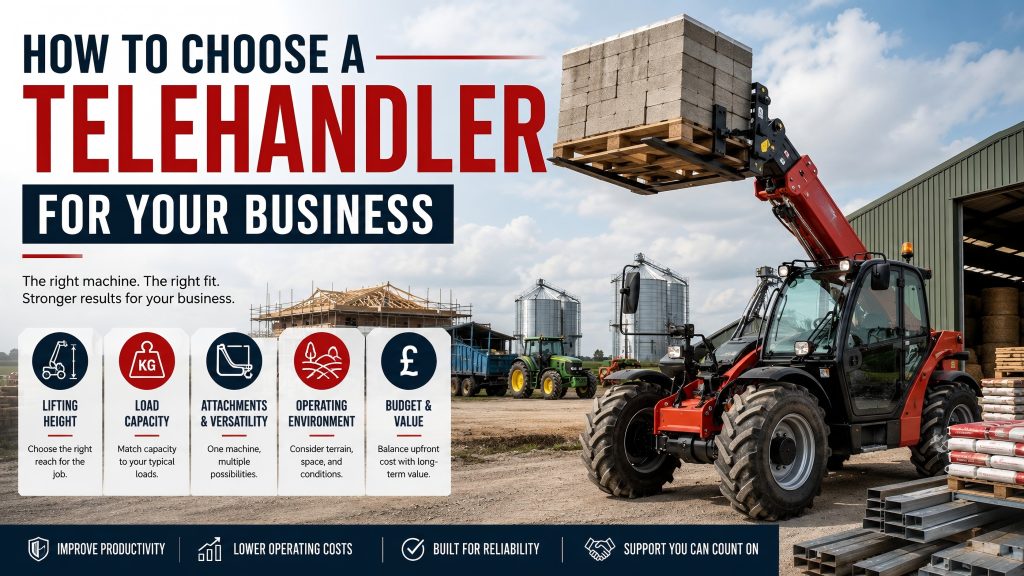
A telehandler is a versatile machine widely used in construction, agriculture, rental, material handling and industrial applications. Compared with a traditional forklift, a telehandler offers greater reach, better off-road performance and more flexible attachment options.
However, choosing the right telehandler is not only about selecting the biggest model. The most suitable machine should match your working conditions, lifting requirements, budget and long-term maintenance needs.
Here are the key factors to consider before buying a telehandler.
1. Confirm Your Required Lifting Capacity
The first thing to check is the load capacity. Different telehandler models are designed for different lifting requirements.
For light farm work or general material handling, a compact telehandler may be enough. For construction sites, rental fleets or heavy-duty lifting work, a larger model with higher rated capacity may be more suitable.
Before choosing a model, you should consider:
Maximum load weight
Common material type
Working frequency
Safety margin
Future application needs
It is usually better to choose a machine with some extra capacity, rather than using a smaller machine at its limit every day.
2. Check the Maximum Lifting Height
Lifting height is another important factor. A telehandler is often used to load materials onto trucks, stack goods, lift pallets, handle hay bales or support construction work at height.
If your work requires higher stacking or loading, you need a model with a longer boom and higher maximum lift height.
For example, a 7-meter telehandler may be suitable for farms, small construction sites and general material handling, while a 10-meter or 14-meter model may be better for larger construction projects or rental applications.
3. Consider the Working Environment
Different working environments require different machine configurations.
For rough outdoor construction sites, you may need strong tires, good ground clearance and reliable off-road performance. For farms, easy operation, good visibility and multiple attachments may be more important. For industrial yards or rental use, durability and easy maintenance are key points.
Common working environments include:
Construction sites
Farms and livestock facilities
Warehouses and yards
Rental fleets
Industrial material handling sites
The more clearly you understand your working conditions, the easier it is to choose the right telehandler.
4. Choose Suitable Attachments
One major advantage of a telehandler is its attachment flexibility. With different attachments, one machine can handle multiple jobs.
Common attachments include:
Pallet forks
Bucket
Jib crane
Bale clamp
Man basket
Snow blade
Material handling attachments
For agriculture, pallet forks, buckets and bale clamps are commonly used. For construction, forks, buckets and lifting jibs are often required. For rental companies, a wider attachment range can make the machine more attractive to customers.
5. Check Engine and Emission Requirements
Different markets may have different engine and emission requirements. For example, some customers may need EPA or Euro V compliant engines, while other markets may focus more on cost-effective and easy-to-maintain engine options.
Before ordering, you should confirm:
Target market emission requirement
Engine brand preference
Fuel type
Maintenance convenience
Spare parts availability
This is especially important for importers, dealers and rental companies.
6. Evaluate Supplier Support
A good telehandler is not only about the machine itself. Supplier support is also important.
Before choosing a telehandler manufacturer, you should check whether the supplier can provide:
Clear technical specifications
OEM/ODM support
Attachment options
Spare parts support
Pre-delivery inspection
Export documents
Responsive communication
For overseas buyers, a reliable manufacturer can help reduce purchasing risks and make the import process easier.
Conclusion
Choosing the right telehandler requires a balance between lifting capacity, lifting height, working conditions, attachments, engine options and supplier support.
Sovol Heavy Industry provides reliable and cost-effective telehandlers for construction, agriculture, rental and material handling applications. With flexible configurations and OEM/ODM manufacturing support, we help overseas customers choose suitable machines for different markets and working conditions.
Looking for a suitable telehandler for your business? Contact Sovol Heavy Industry to discuss your lifting height, load capacity and application needs.